· 6 min read
Tell me you have ADHD without telling me you have ADHD - 1990s style
Yesterday my Mum, sister and nephew visited. It was great to see them. Towards the end of the stay, my Mum handed me an envelope.
Not a fancy one. One of those tired A4 ones that has been in a drawer for decades, the paper having that kind of burnt look around the edges, but preserved for a reason. Inside was a small archive of me. School reports going back to age eleven. Letters I’d written to my Mum over the years. Bits and pieces from a version of myself I hadn’t thought about properly in a long time.
I sat with it this morning and I wasn’t really ready for what reading it would do to me.
Here’s the thing. If you’d shown me these reports five years ago, I’d have shrugged. Bright kid, didn’t apply himself, classic underachiever, moving on. That was the story I’d lived with for thirty years and never questioned.
But I’m reading them post‑diagnosis now. ADHD, in my forties, finally. And every page is screaming it at me. Every single page.
You’d think I’d be angry. I thought I would be too. Mostly I just feel sad for that boy.
The greatest hits:
Let me give you a flavour. These are real quotes. Same boy, different years, different teachers, completely independent of each other.
Physics, January 1993: “J is still making too many silly mistakes. This is because he rushes his answers.”
Physics, July 1993, different term, same observation: “His script was punctuated with many careless errors and was often lacking in detail. He must think more carefully before answering questions in order to avoid the silly mistakes.”
English, June 1990: “J must try to develop his powers of concentration.”
Form teacher, same term: “He is too easily distracted, and doesn’t produce much work.”
Music, same term again: “Works quite well in class but is easily distracted.”
PE, four years later: “His performance has suffered because he frequently loses concentration in lessons.”
And then the one that really got me. Headmaster, February 1990: “A pleasant young man but he rarely stops to think.”
Cluster them together and it’s almost funny. If you scrubbed the dates off and shuffled the cards, you couldn’t tell which year a comment came from. Six time points. Five years. Dozens of different teachers. And every single one of them is essentially writing the same paragraph.
The other phrase that comes up over and over is potential. I have the ability. I could do better. I am producing results some way below his potential. The headmaster wrote that. The year head wrote that, the Chemistry teacher wrote that. They all wrote it because they could see something in conversation that didn’t translate onto the exam paper, and the only framework available to them in 1990s grammar school land was “must try harder”.
What none of them had was the language to say: this kid’s executive function isn’t keeping up with his brain.
The core pattern: careless errors; rushing; distractibility; ability-result gap; exam crashes; verbal-strong-written-weak; is the textbook profile of inattentive-presentation ADHD as it shows up in conscientious boys. Multiple independent observers, multiple years, multiple subjects, same language. That’s strong corroborating evidence even if no single report is decisive.
There’s one more pattern that breaks me a bit. English, January 1994: “His coursework is satisfactory but he does seem to go to pieces in exams.” Geography, same term: “Full marks to J for effort but his exam technique let him down badly this time.” That’s what working memory collapsing under timed pressure looks like.
Coursework was giving me the space to offload. Exams didn’t. You can’t borrow notes from your future self in a hall full of clocks.
The bit that’s harder to write.
There were other things going on at home around then. Family stuff that wasn’t easy. I’m not going to get into it here, they were real, and they were hard, but they weren’t the thing.
The thing was a brain that worked differently and an entire educational system that had no idea how to read it.
The reason no one flagged it is hiding in plain sight in those same reports. “A pleasant cheerful boy.” “Polite and helpful.” “A conscientious student.” In 1990s UK secondary school, ADHD was reserved for the boys throwing chairs across classrooms. If you were polite and well‑behaved and quietly drowning, you got told to develop your powers of concentration and were sent on your way.
You were too well‑behaved to be diagnosed.
Grief is the right word
I keep coming back to this feeling. It’s grief. Properly. For that boy who was working hard to his ability, asking for help, smiling in the corridor, going home and trying again, and being told over and over that he could do better if he just stopped to think.
But I couldn’t stop to think. That was the whole point. Nobody had given me the wiring for that.
I wish I could go back and sit next to that boy and tell him that none of this was a character flaw. That he wasn’t lazy, or thick, or careless in the moral sense. That his brain was working incredibly hard, just not in the way the system was scoring.
I can’t do that, obviously. So I’m doing the next best thing.
My daughter
I am fighting tooth and nail to get her assessed.
I’m not going to pretend I know for certain what’s going on for her. That’s what assessments are for. But I have spent forty‑something years living inside this nervous system, and there are things I recognise. And I am absolutely not interested in her getting to her forties before someone hands her the framework that explains her own brain.
If she has it, she has it. We deal with it now. Support, language, understanding, help that actually fits. Not “develop your powers of concentration”.
That’s the part of all this I can do something about.
Where I am now
I’ve built a career I genuinely love. I work as a Power Platform consultant. The very things that broke me in a Physics exam, the rapid pattern‑matching, the magpie attention, the way I can build rapport with a new client in minutes, those are the same things that make me good at the job. The system that scored me as below potential at sixteen now pays me to think the way I think.
I’ve had brilliant therapy with brilliant counsellors, and I’m medicated. The medication has been life‑changing. Genuinely. For the first time in my life I have a stop button. I had no idea other people had one of those.
It’s not a clean ending. I still have wobbly weeks. I still drive to the West Country and back and feel a bit fried. I still latch onto a shiny new things and ride it harder than is strictly sensible. Moderation is not really my factory setting.
But I know what I’m working with now. I have language for it. And that, more than anything, is what I want for Esme. Not a fixed version of herself. A known one.
This is also a future post for Esme. If you read this, you’ve got this. Things will be difficult but you will grow into a wonderful, well-rounded human who puts kindness first. That is more important to me than any school report.
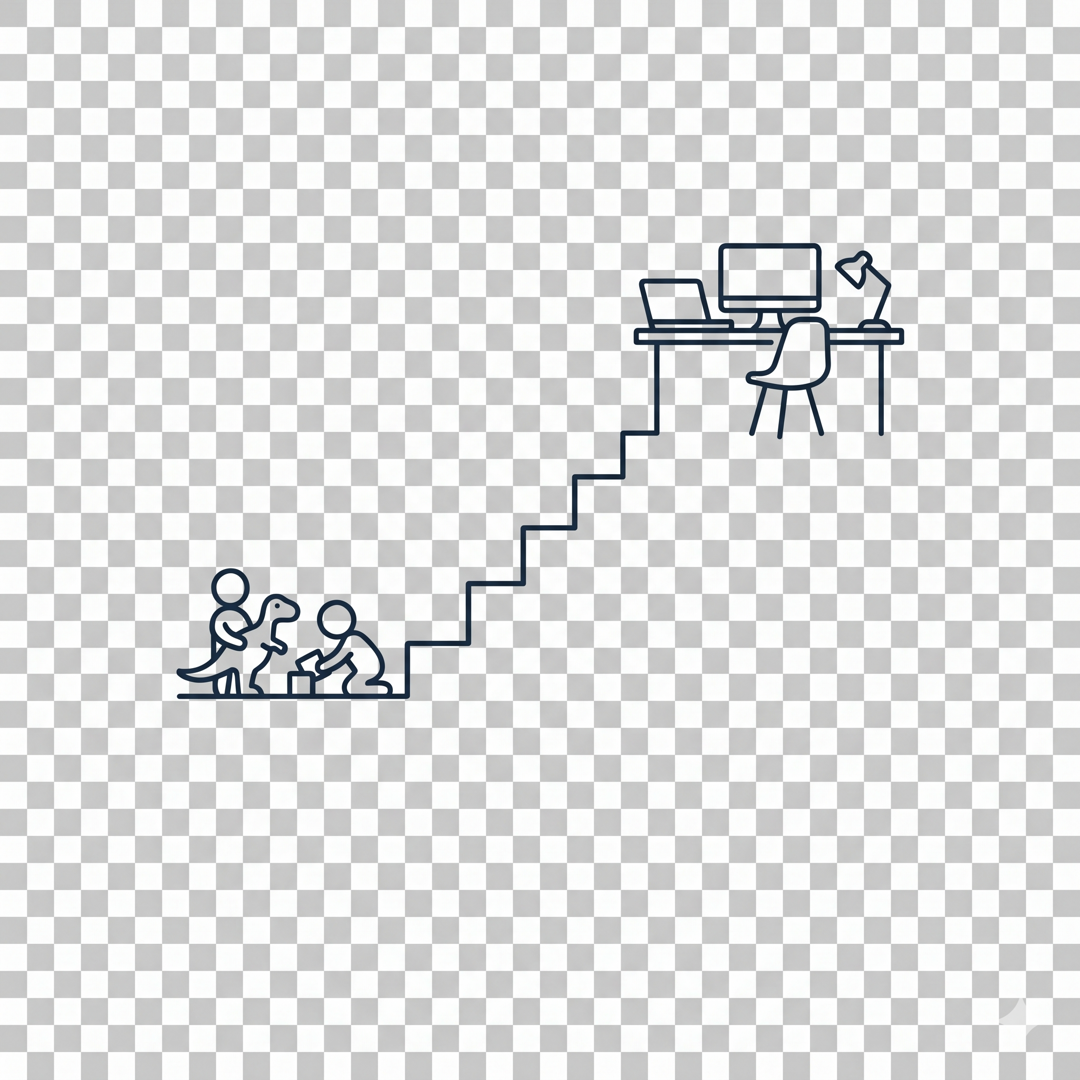
The stairs are behind me. Let’s see how today goes.